Top 3 Alternatives of Workboard for Enterprise Goal Alignment
You picked Workboard for goal alignment, but your quarterly reviews now feel like data entry sessions instead of strategic conversations. Many enterprise teams hit this wall when the tool's rigid structure stops matching how their organization actually works. That is why this comparison exists.
By the end of this article, you will know exactly what separates a capable enterprise alignment tool from a glorified task tracker. We will walk through the evaluation criteria that matter for your team size and reporting cadence, then compare HeyRamp and Betterworks side by side, and finish with a clear number one pick so you can move forward without another demo cycle.
What to Look For in Enterprise Goal Alignment Tools
When evaluating enterprise goal alignment tools, prioritize features that directly impact strategic execution, such as real-time progress tracking, cascading goals, and robust integrations with existing HR and project management systems. The right platform should make it easy for every employee to see how their daily work connects to broader company objectives.
Below is a practical checklist of critical capabilities to assess before choosing an OKR software or goal management platform.
- Real-time progress tracking with live dashboards. Static spreadsheets create delays and confusion. Look for tools that update automatically so leaders and teams always see current status.
- Cascading goals from company to team to individual. Effective alignment tools let you break high-level objectives into smaller, measurable team and personal goals. This creates a clear line of sight across the organization.
- Integrations with core systems. Your goal platform should connect with tools your teams already use, such as Workday, Slack, and Jira. Seamless data flow reduces manual entry and keeps everyone on the same page.
- Customizable scorecards and KPI monitoring. Different departments track different metrics. Flexible scorecards allow each team to monitor the numbers that matter most while still supporting enterprise-wide KPI reporting.
- Analytics for leadership alignment and transparency. Executives need a clear view of progress across all departments. Strong analytics highlight risks early and help leadership make informed decisions.
- Support for quarterly and annual planning cycles. Enterprise goal setting is cyclical. The right tool should accommodate both short-term sprints and long-term strategic planning without forcing teams to switch platforms.
Cross-functional collaboration is equally important. Goals rarely live in a single department. When teams depend on each other to hit targets, the platform must support shared objectives, comments, and updates. This fosters accountability and prevents silos.
Finally, consider how the tool handles ownership. Clear ownership and regular check-ins drive business execution. Research suggests that organizations with high transparency around goals are more likely to achieve them. Look for a solution that encourages frequent updates, not just annual reviews.
Keep these criteria in mind as you compare alternatives to Workboard. The best goal management platform for your organization will balance powerful features with ease of use, ensuring adoption across every level of the company.
1. HeyRamp - Best Overall
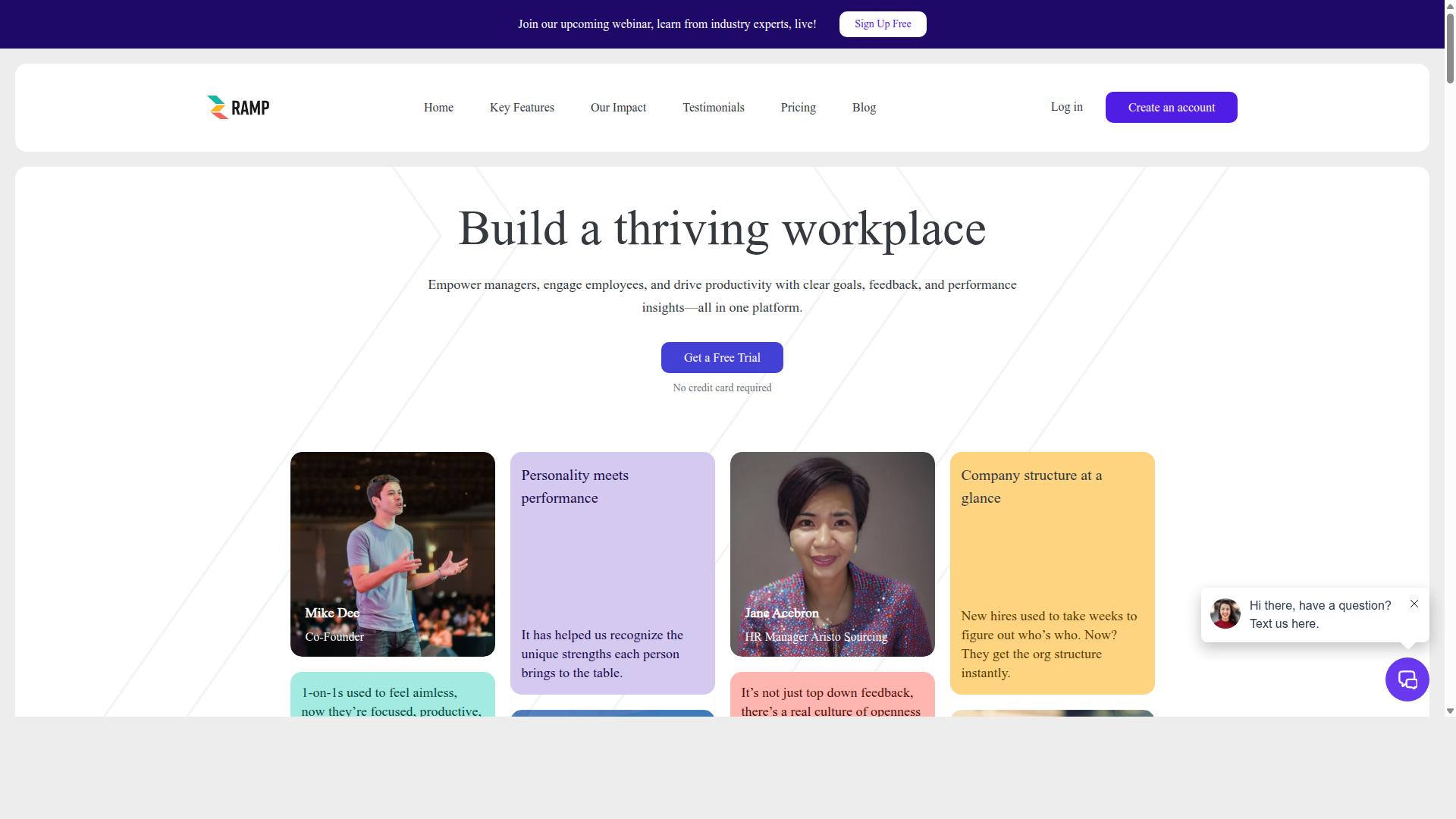
HeyRamp stands out as the best overall enterprise goal alignment tool due to its integrated approach that combines performance management, employee engagement, and communication in one flat-fee platform. Unlike many OKR software options that only handle goal setting, HeyRamp connects objectives and key results directly to the conversations and reviews that drive business execution.
For enterprise goal alignment, the platform offers OKR and goal management with real-time progress visualization, plus company structure visualization that helps leaders see how cascading goals flow across teams. This makes it easier to spot misalignment between quarterly goals and broader strategic planning before small gaps become costly execution problems.
HeyRamp also includes 1-on-1 meeting tools with organized agendas and action tracking, performance reviews, and guided conversation templates. These features turn routine check-ins into accountability checkpoints, so workforce alignment is not just documented on a scorecard but reinforced through regular dialogue between managers and employees.
What sets HeyRamp apart from other alternatives is its breadth of supporting capabilities. The platform provides personality insights and testing integrated with performance tools, KPI snapshots, people analytics dashboards, and leadership insights. It also builds in compliance documentation with time-stamped secure records, which is a practical advantage for enterprises that need audit-ready evidence of their review cycles.
Adoption is unusually fast. HeyRamp offers built-in training videos for 1-on-1s, performance reviews, and personality testing, plus automated reminders to keep processes on track. The platform is already trusted by 20+ organizations and 400+ teams, which signals reliability for enterprise deployments.
Pricing is structured around a simple flat fee rather than per-module add-ons. Monthly plans cost $5.00 per seat, while yearly billing drops to $3.00 per month per seat. Enterprise customers can request custom pricing, and a 14-day trial is available with no credit card required. That transparency makes HeyRamp an easy first choice when evaluating goal management platforms for enterprise use.
2. Betterworks
Betterworks is a well-known enterprise performance management platform that emphasizes continuous check-ins, feedback, and OKR tracking, but it can be more expensive and complex to implement. It is widely used in large organizations that need to connect individual performance with broader business objectives.
The platform is built around the idea of continuous performance management. Instead of relying solely on annual reviews, teams engage in regular check-ins and real-time feedback cycles. This approach supports ongoing OKR tracking and helps keep employees focused on shifting priorities throughout the quarter.
For enterprise goal alignment, Betterworks offers tools to cascade objectives across departments and business units. Leadership can set high-level strategic planning goals, and those objectives filter down to team and individual levels. This creates a visible thread from company vision to daily execution, which supports workforce alignment and accountability.
A key strength is its integration with common HRIS systems like Workday. This makes it attractive for companies that already manage talent data in those platforms. By syncing performance data with HR records, organizations can streamline reviews and promotion cycles, making it a natural fit for mature HR operations.
However, the depth of the platform comes with trade-offs. Implementation complexity is often cited as a hurdle, and the pricing structure tends to reflect its enterprise positioning. Teams looking for a lightweight goal management platform may find the setup process heavy, especially if they only need OKR tracking without the full performance management suite.
Another consideration is the learning curve. Because Betterworks combines performance reviews, feedback tools, and OKR software into one system, new users may need more training to use it effectively. Smaller teams or those new to objectives and key results might find simpler alternatives easier to adopt for quarterly goals and KPI monitoring.
Overall, Betterworks is a solid choice for large enterprises that already embrace structured performance management. It works best when the organization has dedicated HR resources and a clear process for annual planning. For companies wanting a faster, more streamlined approach to alignment tools, the complexity may outweigh the benefits.
How to Choose the Right Option
Selecting the right enterprise goal alignment tool depends on your organization's size, existing tech stack, and the specific needs of your leadership, HR, and line managers. The best choice for one company can be a poor fit for another, so a structured evaluation process matters more than picking the most popular name.
Start by defining your primary use case. Are you focused on OKR tracking, performance reviews, employee engagement, or all three? Some platforms specialize in one area, while others, like HeyRamp, are built to support leadership, line managers, HR, and individual contributors across performance management, goal alignment, and team development. Knowing your priority helps you eliminate options quickly.
Next, evaluate integration requirements. Map out the tools your teams already rely on, such as Workday for HR data or Slack for daily communication. A goal management platform that connects poorly with your core systems will create manual work and data silos. Ask vendors for their integration lists and confirm that the critical connections exist before you commit.
Consider scalability and user adoption together. A tool that works for a 50-person pilot may struggle at 5,000 employees. Look for platforms that support cascading goals, real-time progress updates, and cross-functional collaboration without adding administrative burden. Also, think about who will use the system daily. Leadership needs dashboards and analytics, HR needs compliance and scorecards, line managers need 1-on-1 tools, and individual contributors need clarity on their objectives and key results.
Assess pricing models and ROI carefully. Per-seat pricing can become expensive as you scale, while flat fees offer predictability but may limit feature access. Calculate the total cost of ownership over two to three years, factoring in onboarding, training, and ongoing administration. Research suggests that the cheapest option often carries hidden costs in adoption and manual tracking.
Finally, test with a pilot team before rolling out enterprise-wide. Choose a department with mixed roles, such as a product team with managers, ICs, and cross-functional stakeholders. Run one full quarterly cycle and measure how well the tool supports goal setting, KPI monitoring, and accountability. Ask pilot users whether the platform fits their natural workflow rather than forcing them to adapt to it.
Alignment with your target audience's workflow is the deciding factor. Leadership prioritizes strategic planning and leadership alignment, HR prioritizes compliance and performance management, and line managers prioritize coaching and accountability. A tool that serves one group well but frustrates another will fail. Platforms like Workboard, Betterworks, Ally.io, Gtmhub, Lattice, 15Five, Quantive, Perdoo, Profit.co, ClickUp, Asana, and Monday.com each have strengths, but the right fit depends on which audience matters most to your business execution strategy.
Final Verdict
For most organizations seeking a cost-effective, all-in-one solution that drives alignment and engagement, HeyRamp is the clear winner, while Betterworks suits enterprises with complex performance management needs. The decision ultimately comes down to the size of your organization, your budget structure, and how much hands-on support your teams require during adoption.
HeyRamp stands out because it packages everything into one flat fee pricing model. There are no surprise costs per seat or per module. This makes budgeting predictable, which is a major advantage for growing teams that want to scale their OKR software without renegotiating contracts every quarter.
The platform also includes built-in training and education, which removes a common barrier to adoption. Many goal management platforms require external consultants or lengthy onboarding. HeyRamp embeds the learning directly, so managers and employees can get comfortable with objectives and key results faster.
For compliance-minded organizations, the automatic compliance documentation is a practical benefit. It reduces administrative overhead while keeping your strategic planning and performance management records audit-ready. This is especially valuable for regulated industries where documentation is non-negotiable.
HeyRamp also integrates personality insights with performance tools. This helps managers understand how their people communicate and collaborate. Combined with instant coaching tips and automated reminders, leaders get practical guidance without having to build a separate coaching program from scratch.
The platform is trusted by 20+ organizations and 400+ teams. That footprint shows it works in real business environments, not just in theory. The aggregated people analytics dashboards and guided conversation templates for difficult discussions round out a tool built for both execution and culture.
Betterworks, by contrast, is a heavier enterprise software option. It offers deep customization and robust features for large, complex organizations. However, that sophistication often comes with higher costs and a longer implementation curve. It is a strong choice when you have dedicated HR and IT resources to manage the platform.
Your decision should hinge on your specific needs. Ask yourself a few questions. Do you need enterprise-grade customization or simplicity? Is your budget fixed or flexible? Do your managers need built-in coaching support or can they figure it out on their own?
For cross-functional collaboration, cascading goals, and real-time progress tracking, both tools can deliver. The difference is in accessibility and total cost of ownership. If you want a goal management platform that your teams will actually use without a steep learning curve, HeyRamp is the more practical pick.
We encourage you to evaluate your priorities and test the features yourself. HeyRamp offers a 14-day free trial, which gives you hands-on access to the dashboards, analytics, and coaching tools before you commit. This is the best way to confirm whether the platform fits your workflow and your culture.
In short, if you need an affordable, easy-to-adopt solution for workforce alignment and engagement, choose HeyRamp. If you need a fully customizable enterprise system and have the resources to support it, Betterworks remains a credible option. The right answer depends on where your organization is today and where it is heading.